







TL;DR
Key Decision Points:
- Outsourcing provides 30-50% cost savings, faster scalability, and global expertise, but requires careful vendor management
- Hybrid models combine the best of both approaches, with 67% of UK businesses using some form of mixed strategy
- Decision factors: Budget, timeline, control requirements, IP sensitivity, and long-term vision
Table of content
Choosing between an in-house development team and outsourcing software development is one of the biggest strategic decisions UK businesses face today.
Should you build a dedicated in-house development team within your company, or should you work with external software vendors? According to recent industry data, 48% of UK businesses now outsource at least some of their software development, while 52% use a hybrid approach combining in-house development team resources and external support.
This comprehensive guide explores the pros and cons of building an in-house development team versus outsourcing, helping you make the best choice for your UK business with real-world case studies, cost breakdowns, and actionable insights.
What Is an In-House Development Team?
An in-house development team consists of full-time employees who work exclusively for your company. They are responsible for software development, product updates, ongoing maintenance, and technical innovation.
Best for: Companies that need full control, enhanced security, and long-term scalability with strong alignment to company culture and vision.
Key Characteristics of In-House Teams:
- Permanent employees on your payroll
- Work from your office or as remote company employees
- Deep integration with company culture and processes
- Direct oversight and immediate communication
- Long-term commitment to your products and goals
How to Build an In-House Development Team: A Step-by-Step Process
Step 1: Define Your Technical Requirements and Team Structure
Action Points:
- Assess your project scope: Identify whether you need web development, mobile apps, cloud infrastructure, or full-stack capabilities
- Define required roles: A typical small in-house development team includes:
- 2-3 Full-Stack/Frontend Developers (£45,000-£65,000 each)
- 1-2 Backend Developers (£50,000-£70,000 each)
- 1 DevOps Engineer (£55,000-£75,000)
- 1 Tech Lead/CTO (£70,000-£120,000)
- 1 QA Engineer (£35,000-£50,000)
- Determine tech stack: Choose technologies that align with your product vision and the market availability of talent
- Plan for growth: Design your in-house development team structure to scale from 5 to 15+ developers over 2-3 years
Step 2: Create a Comprehensive Recruitment Strategy
Action Points:
- Develop compelling job descriptions: Highlight your company’s mission, tech stack, growth opportunities, and culture
- Choose recruitment channels:
- Build your employer brand: Create technical blog content, contribute to open source, showcase your engineering culture on social media
- Design rigorous interview processes: Include technical assessments, coding challenges, system design interviews, and culture fit evaluations
Step 3: Establish Competitive Compensation Packages
Action Points:
- Research market rates: Use resources like Tech Nation salary reports, Stack Overflow surveys, and Glassdoor data
- Design total compensation packages:
- Base salary (competitive with London/regional markets)
- Performance bonuses (10-20% of base)
- Share options or equity (0.1-2% for early employees)
- Pension contributions (minimum 3% employer, often 5-8%)
- Healthcare benefits (£500-£1,500 per employee annually)
- Learning and development budget (£1,000-£3,000 per person)
- Consider location flexibility: Remote-first policies can expand your in-house development team talent pool
Step 4: Set Up Infrastructure and Development Environment
Action Points:
- Provision hardware:
- MacBook Pro or high-spec laptops
- Monitors, keyboards, ergonomic equipment
- Development servers or cloud credits
- Secure software licenses:
- IDEs and development tools (JetBrains, Visual Studio)
- Project management tools (Jira, Linear, Asana)
- Communication platforms (Slack, Microsoft Teams)
- Version control and CI/CD (GitHub, GitLab)
- Design tools (Figma, Adobe Creative Cloud)
- Establish office space (if not remote):
- London office space
- Regional UK cities
- Co-working spaces
- Implement security measures: VPNs, endpoint protection, security training, compliance tools
Step 5: Implement Onboarding and Training Programmes
Action Points:
- Create structured onboarding:
- Week 1: Company culture, values, product overview, team introductions
- Week 2: Technical architecture, codebase walkthrough, development environment setup
- Week 3-4: Pair programming, small feature delivery, code review processes
- Month 2-3: Increasing autonomy, ownership of small projects
- Establish continuous learning:
- Weekly tech talks and knowledge sharing sessions
- Conference attendance budget
- Online course subscriptions (Pluralsight, Udemy, Frontend Masters)
- Dedicated learning time (4-8 hours per month)
- Develop internal documentation: Architecture decisions, coding standards, deployment procedures, runbooks
- Implement mentorship programmes: Pair junior developers with seniors for accelerated growth
Step 6: Build Development Processes and Culture
Action Points:
- Establish agile methodologies:
- Sprint planning, daily standups, retrospectives
- Define sprint length (typically 1-2 weeks)
- Implement story pointing and velocity tracking
- Create quality assurance practices:
- Code review requirements (all PRs reviewed by 1-2 peers)
- Automated testing standards (unit tests, integration tests, E2E tests)
- CI/CD pipelines for automated deployment
- Definition of done and acceptance criteria
- Foster engineering culture:
- Regular team retrospectives for continuous improvement
- Blameless post-mortems for incidents
- Innovation time (10-20% time for exploration and technical debt)
- Transparent communication and psychological safety
- Implement performance management:
- Quarterly 1-on-1s and goal setting
- Annual performance reviews linked to compensation
- Career progression frameworks and promotion criteria
Timeline: Expect 6-12 months to establish strong processes and culture with a new in-house development team.
Step 7: Plan for Retention and Growth
Action Points:
- Monitor team health:
- Regular employee satisfaction surveys
- Track turnover rates
- Conduct stay interviews to understand what keeps people engaged
- Invest in career development:
- Clear career ladders (Junior → Mid → Senior → Lead → Principal)
- Technical and management tracks
- Regular skill assessments and growth conversations
- Internal promotion opportunities
- Create engagement initiatives:
- Team building activities and social events
- Recognition programmes for achievements
- Flexible working arrangements
- Mental health and wellbeing support
- Manage technical debt: Allocate 15-25% of sprint capacity to refactoring, upgrades, and maintenance.
Retention Cost: Replacing a developer costs 6-9 months of their salary in recruitment, onboarding, and productivity loss. For a £60,000 developer, this means £30,000-£45,000 per replacement.
Total First-Year Investment for a 5-Person In-House Development Team:
| Cost Category | Amount (£) |
|---|---|
| Salaries (5 developers) | £250,000 – £350,000 |
| Employer NI and pensions | £40,000 – £60,000 |
| Recruitment costs | £20,000 – £40,000 |
| Hardware and equipment | £10,000 – £18,000 |
| Software licenses and tools | £8,000 – £15,000 |
| Office space (if applicable) | £0 – £60,000 |
| Training and development | £10,000 – £20,000 |
| Benefits and perks | £5,000 – £15,000 |
| Total First-Year Cost | £343,000 – £578,000 |
Ongoing Annual Costs (Years 2+):
- Salaries with 5% increases: £262,500 – £367,500
- All other recurring costs: £80,000 – £150,000
- Total: £342,500 – £517,500 annually
What Is Outsourcing Software Development?
Outsourcing means hiring an external agency, consultancy, or freelancer to handle some or all of your development work. This can range from specific projects to entire product development.
Best for: Companies that need cost-efficiency, flexibility, quick scalability, and access to specialised expertise without long-term commitments.
Types of Outsourcing Models:
- Project-Based Outsourcing: Fixed scope, timeline, and cost for specific deliverables
- Dedicated Team Outsourcing: An Extended team that works exclusively on your project
- Staff Augmentation: Temporary specialists who integrate with your existing team
- Offshore Development: Teams in lower-cost countries (India, Eastern Europe)
- Nearshore Development: Teams in nearby countries with similar time zones (EU for UK businesses)
Comparing In-House Development vs. Outsourcing
| Factor | In-House Development Team | Outsourcing |
|---|---|---|
| Control | High – Full oversight over development, priorities, and pivots | Lower – Dependence on external vendors, shared resources |
| Cost (Year 1) | High – £343,000-£578,000 for 5-person team | Lower – £150,000-£400,000 for equivalent capacity |
| Cost (Long-term) | Stable – £340,000-£520,000 annually with gradual increases | Variable – Flexible based on project needs |
| Talent Access | Limited – Restricted to local/remote talent willing to be employees | Global – Access to worldwide expertise and niche skills |
| Scalability | Slow – Hiring takes 2–3 months per role | Fast – Scale up or down within weeks |
| Time to Build | Long – 6–12 months to build an effective team | Quick – Start within 2–4 weeks |
| Communication | Excellent – Same location, culture, immediate access | Challenging – Time zones, language barriers, cultural differences |
| IP Security | Strong – Full ownership, confidentiality controls | Moderate – Requires robust contracts and NDAs |
| Long-Term Viability | Strong – Grows with company culture and knowledge | Depends on vendor reliability and relationship management |
| Knowledge Retention | High – All expertise stays within the company | Risk – Knowledge leaves when the contract ends |
| Flexibility | Low – Fixed costs regardless of workload | High – Pay for what you need when you need it |
| Quality Control | Direct – Immediate oversight and standards enforcement | Indirect – Dependent on vendor processes and accountability |
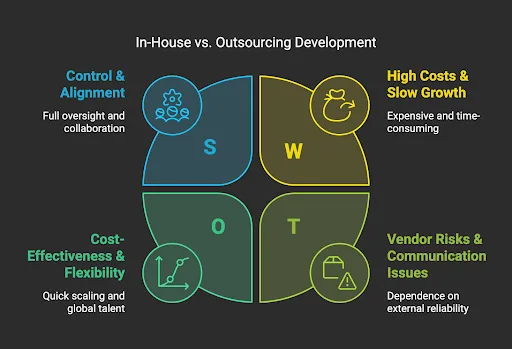
Key Takeaway: If control, security, and long-term product ownership are your top priorities, an in-house development team is the best choice. If you need cost-effectiveness, rapid scaling, and access to specialised skills, outsourcing is the better option.
UK/EU Case Studies: Real-World Examples
Case Study 1: How Revolut Scaled Its Engineering Team for Success
Company: Revolut (London, UK)
Industry: Financial Technology
Decision: In-house development team
Timeline: 2015-present
Context: Revolut, the British financial technology company offering banking services, needed to maintain absolute control over its rapidly evolving platform offering currency exchange, stock trading, cryptocurrency management, and banking services.
Approach:
- Built a large in-house development team from scratch
- Established engineering hubs in London, Porto, Krakow, and other cities
- Invested heavily in recruitment, competitive salaries and equity packages
- Developed proprietary technology and microservices architecture
- Implemented stringent security standards for financial compliance
Decision Factors:
- Regulatory compliance: Financial services require extreme security and compliance controls
- IP protection: Competitive advantage depends on proprietary algorithms and features
- Speed of innovation: Requires rapid iteration and direct customer feedback loops
- Long-term vision: Building a global financial super-app requires sustained commitment
Outcomes:
- Maintained full control over innovative features and competitive differentiation
- Achieved 35+ million customers globally by 2024
- Retained complete IP rights and proprietary technology
- Built a strong engineering culture with high retention rates
- Responded quickly to regulatory changes and customer needs
Case Study 2: Monzo Bank’s In-House Platform Development
Company: Monzo Bank (London, UK)
Industry: Digital Banking
Decision: In-house development team
Timeline: 2015-present
Context: Monzo needed to build a modern, mobile-first bank from the ground up with real-time notifications, budgeting tools, and savings features that required deep integration with banking infrastructure.
Approach:
- Recruited talented developers and engineers (team grew to 500+ by 2023)
- Established a collaborative engineering culture with transparency and open communication
- Built a platform on AWS for scalability and reliability
- Focused heavily on regulatory compliance and data security
- Created a strong engineering blog and an open-source presence to attract talent
Decision Factors:
- Regulatory requirements: Banking requires absolute control over security and compliance
- Customer trust: Direct control ensures data protection and privacy
- Product differentiation: Unique features require custom development
- Technical complexity: Banking infrastructure requires deep expertise and long-term maintenance
Outcomes:
- Successfully obtained a full banking licence in 2017
- Maintained 99.99% uptime on critical banking services
- Built a robust, scalable platform handling millions of transactions daily
- Created a strong engineering brand, attracting top talent
- Achieved £4.5 billion valuation
Architecture Highlight: Monzo’s microservices architecture on AWS comprises over 1,500 microservices, enabling rapid feature development while maintaining stability and security.
Case Study 3: Slack’s Early Outsourcing Strategy
Company: Slack
Industry: Team Collaboration Software
Decision: Outsourcing initial development
Timeline: 2012-2013 (initial development phase)
Context: Slack, before becoming the billion-dollar company it is today, started as a pivot from a gaming company called Tiny Speck. The founders needed to quickly build and launch a communication tool without the significant investment required for a full in-house development team.
Approach:
- Partnered with MetaLab, a design and development agency, for initial product development
- MetaLab provided UI/UX design and frontend development expertise
- Focused internal resources on core backend infrastructure and business development
- Used outsourcing to validate product-market fit before committing to a full in-house development team
Decision Factors:
- Limited runway: Requires fast launch despite constrained capital
- Speed to market: Outsourcing accelerated development
- Expertise access: MetaLab brought world-class design skills not available internally
- Risk mitigation: Could pivot or abandon without large team overhead
Outcomes:
- Launched a high-quality product within 6 months
- Achieved product-market fit rapidly with initial users
- Gained traction quickly, enabling later in-house development team building
- Eventually transitioned to a large in-house development team as the company scaled
Case Study 4: UK HealthTech Startup – Babylon Health
Company: Babylon Health (London, UK)
Industry: Digital Healthcare
Decision: Hybrid model (in-house development team + outsourcing)
Timeline: 2013-2023
Context: Babylon Health needed to build a complex AI-powered healthcare platform combining telemedicine, symptom checking, and health monitoring while managing costs and scaling rapidly.
Approach:
- Built a core in-house development team for critical systems: AI algorithms, patient data security, clinical integrations
- Outsourced non-core components: mobile app features, UI/UX enhancements, testing
- Used nearshore teams in Eastern Europe for cost-effective scaling (Poland, Romania)
- Maintained in-house development team control of medical algorithms and patient data
Decision Factors:
- Regulatory compliance: NHS and healthcare regulations require an in-house development team to have security controls
- Cost efficiency: Outsourcing non-critical features reduced burn rate
- Scalability: Could quickly add capacity for new market launches
- Expertise: In-house development team medical AI expertise, combined with outsourced general development
Outcomes:
- Served 24+ million patients globally by 2023
- Maintained rigorous NHS compliance and data security standards
- Achieved faster time-to-market in new regions through flexible outsourcing
- Reduced development costs compared to a fully in-house development team model
- Successfully balanced control with cost-efficiency
Challenges Faced:
- Communication overhead in managing distributed teams
- Quality variance between the in-house development team and the outsourced code
- Knowledge transfer difficulties when bringing outsourced work in-house development team
Case Study 5: UK E-commerce Company – ASOS Technology Journey
Company: ASOS (London, UK)
Industry: Online Fashion Retail
Decision: Transitioned from outsourcing to an in-house development team
Timeline: 2000-present
Context: ASOS initially outsourced development but gradually built one of the UK’s largest in-house development teams as the company scaled from a startup to a £3+ billion revenue company.
Phase 1: Early Days (2000-2005) – Outsourcing
- Used external agencies for website development and e-commerce platform
- Allowed fast launches with limited capital
Phase 2: Transition (2006-2012) – Hybrid
- Began building an in-house development team while maintaining agency relationships
- Hired senior engineers to lead internal development
- Gradually brought the core platform in-house
Phase 3: In-House Focus (2013-present)
- Established engineering hubs and moved all critical systems to the in-house development team
- Invested in proprietary warehouse management, logistics, and customer experience platforms
Decision Factors for Transition:
- Scale: Complexity required dedicated long-term expertise
- Competitive advantage: Needed proprietary technology for differentiation
- Quality control: Direct oversight improved stability and performance
- Cost at scale: The in-house development team became more cost-effective at their volume
Outcomes:
- Successfully scaled platform to handle 26 million active customers
- Reduced external dependencies and improved system reliability
- Built a strong engineering culture, attracting top UK tech talent
- Enabled rapid innovation in mobile apps, personalisation, and logistics
Pros and Cons of Building an In-House Tech Team
Advantages of an In-House Development Team
✔ Full Control Over Software Development
- Direct oversight of priorities, timelines, and technical decisions
- Ability to pivot quickly based on market feedback
- Complete ownership of product direction and technical architecture
✔ Better Communication & Collaboration
- Immediate access to developers without scheduling delays
- Shared office culture (or seamless remote setup)
- Faster problem-solving through direct interaction
- Real-time collaboration with product, design, and business teams
✔ Stronger Alignment with Company Goals
- Developers understand the company vision, culture, and long-term strategy
- Greater investment in product success and company growth
- Easier knowledge transfer and institutional memory
- In-house development team grows alongside the company
✔ Enhanced Security and IP Protection
- Direct control over code repositories, credentials, and sensitive data
- Reduced risk of IP theft or unauthorised access
- Easier compliance with GDPR, ISO 27001, and industry regulations
- Complete confidentiality over proprietary algorithms and business logic
✔ Long-Term Cost Efficiency
- Lower per-unit costs as the in-house development team becomes more efficient over time
- No agency margins or markup on developer time
- Retained knowledge reduces rework and technical debt
- Better ROI for long-term, ongoing development needs
✔ Higher Quality and Consistency
- Developers deeply understand the codebase and architecture
- Consistent coding standards and practices across the in-house development team
- Greater accountability for technical debt and long-term maintainability
- Pride of ownership leads to higher quality work
✔ Faster Innovation
- No contract negotiations or vendor approvals for new features
- Developers can experiment and prototype freely
- Direct customer feedback loops enable rapid iteration
- Greater flexibility to pursue technical innovation
Disadvantages of an In-House Development Team
✘ High Initial and Ongoing Costs
- Fixed costs regardless of workload or project pipeline
- Significant recruitment expenses
✘ Slower Hiring & Scalability
- Average 29-43 days to hire one senior developer
- Difficult to scale down during slow periods without layoffs
- Limited flexibility for seasonal or project-based needs
✘ Risk of Employee Turnover
- Replacing a developer costs £30,000-£45,000 in recruitment and lost productivity.
- Knowledge loss when key in-house development team members leave
- Continuous recruitment burden to maintain team size
✘ Limited Access to Specialised Skills
- Geographic constraints limit the in-house development team talent pool (even with remote work)
- Expensive to hire niche specialists for short-term needs
- Difficulty competing with larger tech companies for top talent
- Training costs to upskill the in-house development team for new technologies
✘ Management Overhead
- Requires dedicated tech leadership (CTO, Engineering Manager)
- HR processes for performance management, career development
- Administrative burden for benefits, payroll, and compliance
- More complex organisational structure as the in-house development team grows
✘ Infrastructure and Operational Costs
- Office space, equipment, software licenses
- Benefits, pensions, healthcare, and learning budgets
- Legal and HR support for employment contracts and disputes
- Ongoing training and development investments
✘ Slower Time to Market Initially
- Learning curve for the company domain and existing systems
- Delays while the in-house development team is being assembled and onboarded
- Opportunity cost of waiting to launch
Pros and Cons of Outsourcing
Advantages of Outsourcing
✔ Cost-Effective – No Long-Term Hiring Expenses
- No benefits, pensions, office space, or equipment costs
- Pay only for work delivered, not idle time
- Predictable project-based budgets
✔ Quick Scalability – Easy to Adjust Resources
- No long recruitment processes or severance costs
- Flexible capacity for seasonal or variable workloads
- Easy to add specialists for specific projects
✔ Access to Global Expertise
- Tap into a worldwide talent pool with diverse skills
- Access niche specialists (blockchain, AI/ML, specific frameworks) without full-time commitment
- Benefit from the agency’s accumulated knowledge across multiple projects
- Work with teams that have industry-specific experience
✔ Faster Time to Market
- Pre-assembled teams with established workflows
- No training period or onboarding delays
- Immediate access to experienced developers
✔ Reduced Administrative Burden
- No HR management, payroll, or employment law concerns
- No performance reviews or career development responsibilities
- Simpler contracts and invoicing
- Vendor manages team logistics and operations
✔ Focus on Core Business
- Internal teams can focus on strategy, sales, and customer relationships
- No distractions from managing engineering operations
- Leverage external expertise while concentrating on business growth
- Reduced operational complexity
✔ Risk Mitigation for New Projects
- Test ideas with limited commitment before full in-house development team investment
- Easy to pivot or cancel if the project doesn’t succeed
- No long-term obligations if business direction changes
- Lower financial risk for experimental initiatives
Disadvantages of Outsourcing
✘ Less Direct Control Over the Development Process
- Dependence on the vendor’s priorities and capacity
- Shared resources with other clients may cause delays
- Difficult to implement last-minute changes or pivots
- Less visibility into day-to-day progress
✘ Communication Challenges
- Time zone differences (especially with offshore teams)
- Language and cultural barriers can cause misunderstandings
- Slower response times for urgent issues
- Requires more detailed documentation and specifications
✘ Quality Risks – Depends on Vendor Reliability
- Inconsistent code quality across different outsourcing firms
- Less accountability for long-term maintainability
- Potential for “good enough” work rather than excellent work
- Difficulty ensuring adherence to your standards and practices
✘ Security and IP Concerns
- Sharing sensitive code and data with external parties
- Risks of IP theft or unauthorised use
- Complex NDA and contract requirements
- Compliance challenges with GDPR and data protection regulations
✘ Knowledge Retention Issues
- Expertise leaves when the contract ends
- Difficult to maintain institutional knowledge
- Dependent on vendor documentation quality
- Potential challenges transitioning to an in-house development team or a new vendor
✘ Hidden Costs and Budget Overruns
- Scope creep can increase costs significantly
- Additional costs for project management and coordination
- Rework due to miscommunication or misalignment
- Potential for vendor lock-in with proprietary solutions
✘ Integration Challenges
- Difficulty integrating the outsourced team with the company culture
- Lack of ownership and commitment compared to the in-house development team employees
- Coordination overhead between internal and external teams
- Alignment challenges with the company vision and values
Which Model Is Best for Your Business?
Choose an In-House Development Team if:
You need full control over the product – Critical for complex, proprietary platforms where competitive advantage depends on technology (e.g., fintech, AI-driven products, regulated industries)
You have a long-term vision and can afford the higher costs – Building a sustainable platform that will evolve for 5-10+ years requires a committed in-house development team with expertise
Security and intellectual property are top priorities – Industries like banking, healthcare, defence, and legal tech require absolute control over sensitive data and proprietary algorithms
Your product is your core differentiator – If technology is central to your business model and competitive advantage, in-house development team control is essential
You need deep domain expertise and institutional knowledge – Complex domains (medical devices, scientific computing, financial algorithms) benefit from long-term in-house development team knowledge retention
You’re building a scalable, ongoing platform – SaaS products, marketplaces, and platforms with continuous feature development justify an in-house development team investment
You have predictable, consistent development needs – If you need full-time capacity year-round, an in-house development team becomes cost-effective
Strong company culture and team alignment are critical – Mission-driven organisations and startups, where culture is a competitive advantage, benefit from in-house development teams
Example UK businesses: Revolut, Monzo, Deliveroo, TransferWise (now Wise), Funding Circle, Checkout.com
Choose Outsourcing if:
You want faster scalability and cost savings – Startups with limited runway or businesses testing new markets benefit from lower initial investment
You need specialised expertise not available internally – Short-term need for blockchain developers, AI specialists, or specific framework expertise
You have short-term or flexible project needs – MVP development, one-off projects, seasonal capacity requirements, or experimental initiatives
Speed to market is your top priority – Need to launch within 3-6 months rather than waiting 12+ months to build an in-house development team
You’re a non-tech company needing software – Traditional businesses (retail, manufacturing, professional services) building supporting tools rather than core tech products
You want to validate product-market fit first – De-risk significant in-house development team investment by proving the concept with outsourced development
You have a variable or unpredictable workload – Agencies, consultancies, or project-based businesses with fluctuating development needs
Budget constraints require immediate cost control – Need to minimise fixed costs and maintain financial flexibility
Example UK businesses: Early-stage startups, e-commerce companies, professional services firms, traditional retailers building digital capabilities
Consider a Hybrid Model if:
You want the best of both approaches – Maintain in-house development team control of core systems while outsourcing non-critical features
You need to scale rapidly while maintaining quality – Use an in-house development team for architecture and critical features, outsource for additional capacity
Different parts of your product have different requirements – Keep sensitive, regulated, or IP-critical work in the in-house development team, outsource commodity features
You’re transitioning from outsourcing to in-house – Gradually build internal in-house development team capability while maintaining outsourced support during transition
Hybrid model examples:
- Core in-house, features outsourced: Babylon Health (medical AI in in-house development team, mobile features outsourced)
- Architecture in-house, implementation outsourced: In-house development team designs system, external teams build modules
- Staff augmentation: In-house development team supplemented with external specialists for specific skills or capacity
- Phase-based transition: Start with outsourcing for MVP, gradually build an in-house development team as you scale
Decision-Making Flowchart
Use this flowchart to determine the best model for your business:
START: Do you have a £300,000+ budget for first-year team building?
│
├─ NO → Consider Outsourcing
│ │
│ └─ Do you need to launch within 6 months?
│ │
│ ├─ YES → Outsource initial development
│ │ Consider transitioning to in-house after product-market fit
│ │
│ └─ NO → Hybrid approach: Start with outsourcing,
│ gradually build in-house capability
│
└─ YES → Is technology your core competitive advantage?
│
├─ YES → Is your product in a regulated industry (finance, healthcare)?
│ │
│ ├─ YES → Build in-house team
│ │ Security and compliance require direct control
│ │
│ └─ NO → Do you have ongoing, predictable development needs?
│ │
│ ├─ YES → Build in-house team
│ │ Long-term cost efficiency at scale
│ │
│ └─ NO → Hybrid model
│ In-house for core, outsource for projects
│
└─ NO → Are you testing a new market or MVP?
│
├─ YES → Outsource initially
│ Validate before a major investment
│
└─ NO → Do you need specialised skills temporarily?
│
├─ YES → Staff augmentation or project outsourcing
│ Bring in experts without full-time commitment
│
└─ NO → Evaluate hybrid model
Balance control with flexibility
Key Takeaways
Cost Comparison Summary
| Aspect | In-House Development Team | Outsourcing (Equivalent capacity) |
|---|---|---|
| Fixed vs Variable | Fixed costs regardless of workload | Variable, scales with needs |
| Break-even Point | 2–3 years for long-term projects | Better for short-term (<2 years) |
Strategic Decision Framework
Choose the In-House Development Team. When:
- Technology is core to the business model
- Security and compliance are critical
- Long-term commitment (3+ years) to product development
- Need for deep institutional knowledge and culture alignment
Choose Outsourcing When:
- Need to launch quickly (within 3-6 months)
- Limited budget (<£200,000 for development)
- Testing product-market fit before a major in-house development team investment
- Short-term or project-based needs
- Need for specialised expertise unavailable locally
Choose Hybrid When:
- Want an in-house development team to control core systems, but need additional capacity
- Transitioning from startup to scale-up phase
- Have variable workload (core in-house development team + flex capacity)
- Different security/compliance requirements for different components
UK Market Statistics
- Time to hire: 29-43 days per senior developer
- Outsourcing cost savings: 30-50% compared to an in-house development team (depending on location)
- Hybrid model adoption: 67% of UK scale-ups use a mixed approach
- UK tech sector contribution: £184 billion to the UK economy annually
Critical Success Factors
For In-House Development Teams:
- Strong leadership (experienced CTO or Tech Lead)
- Competitive compensation packages (salary + equity + benefits)
- Clear career progression and learning opportunities
- Robust onboarding and knowledge transfer processes
- Focus on retention
For Outsourcing:
- Thorough vendor vetting (portfolio, references, case studies)
- Clear contracts with deliverables, timelines, and quality standards
- Regular communication cadence (daily standups, weekly reviews)
- Detailed documentation and knowledge transfer plans
- Intellectual property protections (NDAs, code ownership clauses)
For Hybrid Models:
- Clear boundaries between the in-house development team and outsourced work
- Strong technical leadership to maintain architectural coherence
- Effective communication tools and processes across teams
- Consistent code quality standards and review processes
- Plan for a gradual transition to an in-house development team as the company scales
Final Thoughts
Both in-house development teams and outsourcing have their strengths and weaknesses. The right choice depends on your specific business context, budget, timeline, and long-term vision.
For long-term stability, control, and competitive advantage → Choose an in-house development team.
- Best for fintech, healthtech, SaaS platforms, and any business where technology is the core product
- Plan for 12-24 months to build a mature, high-performing in-house development team
For flexibility, speed to market, and lower initial costs → Choose outsourcing
- Ideal for MVPs, project-based work, and testing product-market fit
- Save compared to in-house, especially with nearshore/offshore teams
- Start development within 2-4 weeks rather than waiting 6-12 months
For a balanced approach → Choose a hybrid model
- Keep security-critical and proprietary code in the in-house development team
- Outsource non-core features, capacity surges, and specialised expertise
Key Success Factors
Whatever model you choose:
- Start with clear requirements – Ambiguity creates costly mistakes
- Budget realistically – Include hidden costs (recruitment, training, management overhead)
- Plan for the long term – Today’s decision affects your business for years
- Prioritise communication – Poor communication kills projects regardless of the model
- Focus on quality – Cutting corners on quality costs more in rework than saving upfront
- Be prepared to adapt – Most successful companies evolve their approach over time
Taking Action
Ready to build an in-house development team?
- Review the comprehensive “How to Build an In-House Development Team” section above.
- Connect with UK tech recruitment specialists
- Explore UK government apprenticeship schemes
- Research competitive salary benchmarks
- Learn about building an engineering culture
Considering outsourcing?
- Develop detailed project requirements and acceptance criteria
- Research UK and nearshore development agencies
- Request case studies and client references
- Read about selecting the right development partner
- Understand software development contracts
Need expert advice on choosing the right model? Get in touch with a development consultant who understands the UK market and can provide personalised recommendations based on your specific situation.
Whether opting for in-house development or outsourcing, focusing on maximising returns on MVP investments ensures efficient use of resources. Consider exploring product growth strategies to complement your development approach.
Frequently Asked Questions (FAQs)
Is it better to hire a dedicated development team or outsource?
It depends on your budget, timeline, and control needs. An in-house development team is ideal for long-term projects where technology is your competitive advantage, particularly in regulated industries like fintech and healthcare.
Outsourcing is best for flexibility, cost savings (30-60% less), and speed to market. It works well for MVP development, project-based work, or when you need specialised expertise temporarily. Many UK startups outsource initially, then build in-house teams after proving product-market fit.
What's the biggest risk of outsourcing software development?
The biggest risk is vendor reliability and quality control. Poor communication or inadequate processes can lead to quality issues, knowledge loss, and hidden costs (scope creep can increase costs by 30-50%).
How to mitigate risks:
- Thoroughly vet vendors (portfolio, references, certifications)
- Establish clear contracts with detailed scope and SLAs
- Maintain active oversight with daily standups and code reviews
- Choose the right engagement model (fixed-price, time & materials, or dedicated team)
Consider staff augmentation as a flexible alternative that provides more control. UK-specific tip: Look for vendors with UK office presence and GDPR compliance expertise.
Can I use both an in-house team and outsourcing?
Yes! A hybrid model is increasingly popular. Common strategies include:
- Core in-house, features outsourced: Keep proprietary code internal, outsource UI/UX and integrations
- Staff augmentation: Maintain a core team, augment with external specialists
- Project-based outsourcing: In-house handles ongoing work, outsources discrete projects
- Phase-based transition: Start outsourced for MVP, gradually build in-house
Best practices: Establish clear ownership boundaries, maintain consistent code standards, use shared tools, and document everything for knowledge transfer.
Explore product development strategies to optimise your hybrid approach.
How do I ensure quality when outsourcing software development?
Quality requires proactive management:
- Pre-engagement: Review portfolios, check references, verify certifications
- Clear requirements: Detailed specifications, acceptance criteria, compliance standards
- Quality gates: Code reviews, automated testing (80% coverage), security scanning
- Strong governance: Daily standups, weekly reviews, monthly steering meetings
- Technical oversight: Assign internal tech lead, conduct regular code audits
- Accountability contracts: SLAs with penalties, bug fix guarantees, and warranty periods
- Knowledge transfer: Comprehensive documentation, walkthroughs, runbooks
Track metrics like code quality scores, test coverage, bug density, and system uptime.
What industries benefit most from in-house development teams?
Industries that benefit from in-house teams:
- Financial Technology (Fintech): Regulatory compliance, proprietary algorithms, data security
- Healthcare/HealthTech: Patient privacy (GDPR, NHS standards), medical device regulations
- Enterprise SaaS: Complex architecture, ongoing development, customer data security
- Cybersecurity: Proprietary detection algorithms, security-critical code
- E-commerce/Marketplaces: Competitive differentiation, personalisation, scale
Industries that often outsource successfully:
- Professional Services: Software as a supporting tool, project-based needs
- Traditional Retail: Standard e-commerce features, infrequent updates
- Manufacturing: Operational efficiency software, standard functionality
- Hospitality/Tourism: Booking platforms with standard features, seasonal demand
Decision framework:
- High regulatory requirements → In-house (compliance control)
- Proprietary IP critical → In-house (competitive advantage)
- Standard functionality → Outsource (cost efficiency)
- Supporting business tool → Outsource or hybrid
Learn about technology choices for startups to make informed decisions for your industry.
How has Brexit affected outsourcing decisions for UK companies?
Brexit has significantly impacted development strategies:
Key changes:
- Increased nearshore outsourcing to EU: Poland, Romania, Portugal, Spain (time zone alignment, GDPR compliance)
- Hiring challenges: New visa requirements for EU developers (£1,500-£2,000 additional cost, 4-8 weeks processing)
- Remote-first trend: 40% of UK tech companies now remote-first, expanding domestic talent pools
- Global hiring: Growth in hiring from Canada, Australia, UAE, Singapore via Employer of Record services
- Domestic talent focus: Apprenticeship programsme, graduate schemes, “grow your own” strategies
Strategic implications:
- In-house: Budget for higher recruitment costs, longer timelines for international hires
- Outsourcing: EU nearshore increasingly attractive vs. traditional offshore
- Hybrid: Use EOR for remote international employees alongside the UK core team
Practical advice:
- Allow extra time for visa processing
- Consider EU nearshore agencies for quick scaling
- Explore remote-first hiring across the UK
- Investigate UK apprenticeship schemes for junior talent
Understanding how to choose the right development partner is crucial in the post-Brexit landscape.
