





Table of content
TL;DR: When evaluating custom AI vs off-the-shelf AI, companies must balance speed, cost, and control. Off-the-shelf AI delivers quick wins but limits flexibility and ownership. Custom AI development demands more investment yet offers scalability, compliance readiness, and long-term IP value. The right choice depends on your industry, growth stage, and strategic goals.
Introduction: Why This Choice Matters More Than Ever
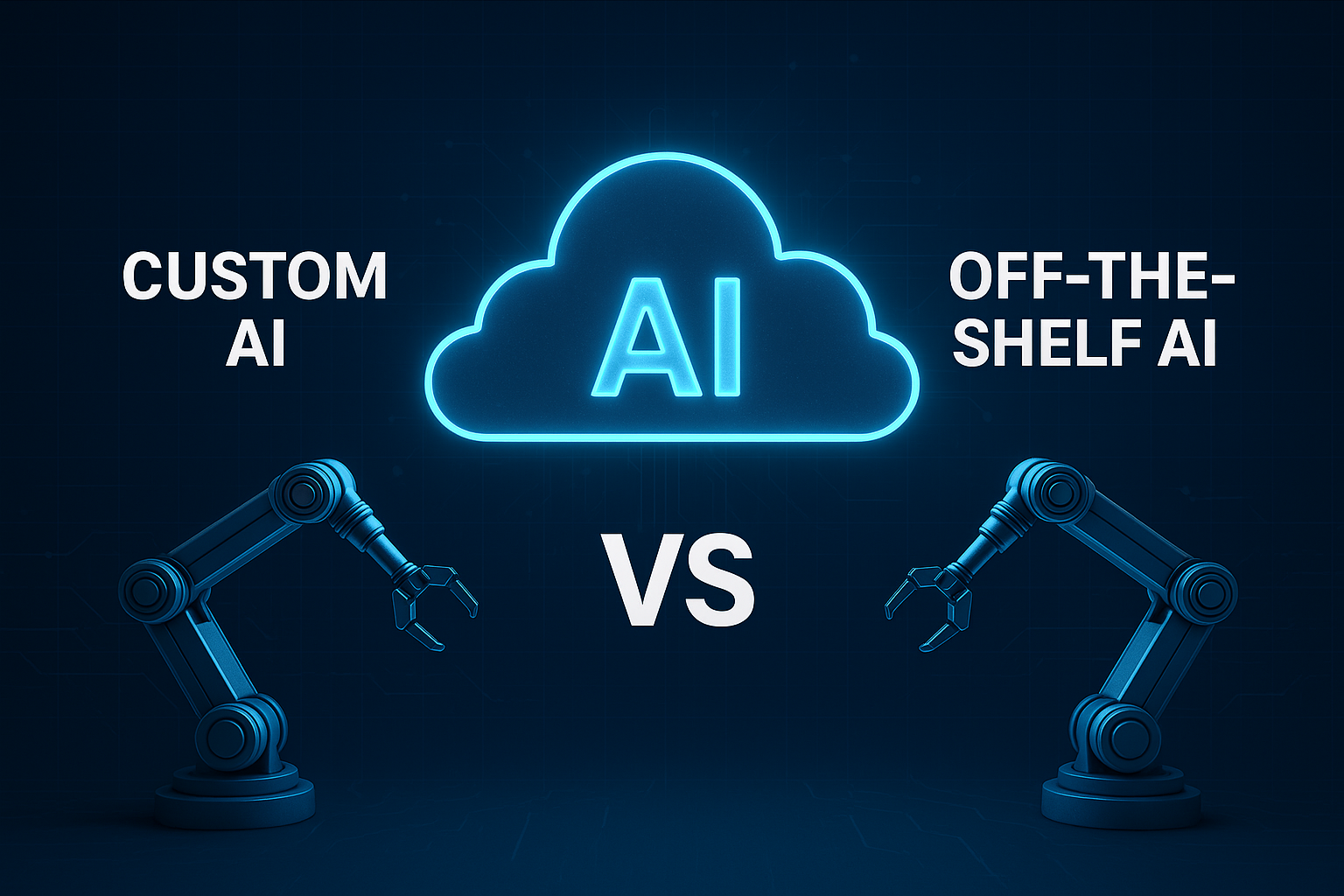
Artificial intelligence has moved from being experimental to essential. Businesses across every sector now rely on AI to improve efficiency, personalise customer experiences, and reduce risk. Yet before these benefits can be realised, decision-makers face a defining question: should they rely on off-the-shelf AI tools that are ready to deploy, or should they pursue custom AI development tailored to their unique workflows?
This choice shapes how secure your data will be, how adaptable your systems become, and how much trust you earn from customers and investors.
At RSVR Tech, where our AI Services integrate innovation with strong cybersecurity principles, we’ve seen companies thrive when they selected the right approach — and others falter when they underestimated the risks. For early-stage founders, this decision can even affect how fundable you appear to investors.
According to McKinsey’s 2023 State of AI Report, 63 % of businesses using AI saw revenue increases, yet many flagged cybersecurity and compliance as top challenges. Clearly, the opportunity is large, but so are the responsibilities.
What is Off-the-Shelf AI and Why Do Businesses Use It?
Off-the-shelf AI refers to pre-built artificial intelligence systems that companies can adopt without custom development.
Common examples include chatbots, analytics platforms, and cloud-based recommendation engines.
Why companies choose off-the-shelf AI tools:
- They are affordable and quick to implement
- No need for in-house AI expertise
- They offer fast wins to prove value
A retailer might deploy a chatbot in days, while a logistics company might use predictive analytics without building models from scratch. In fact, Airbnb used off-the-shelf machine learning libraries in its early days to optimise pricing and search — helping it scale quickly without needing to build custom AI.
However, those benefits come with trade-offs: the same toolset is often available to rivals, reducing differentiation, and handling of sensitive data by third-party systems introduces compliance and security risks.
What is Custom AI and How Does It Benefit Businesses?
Custom AI development creates systems built specifically for your business, using proprietary data and workflows.
Key advantages of custom AI development:
- Ownership of intellectual property (algorithms, models, data systems)
- Full control over how data is processed and secured
- Tailored AI benefits that match your exact operations
- Scalability and resilience aligned with your growth
For instance, JPMorgan Chase built its own AI system, COiN, because off-the-shelf tools could not meet its compliance standards. With their custom AI, they cut contract review time from thousands of hours to seconds — all while keeping sensitive data secure.
Of course, custom AI development usually takes months and requires data quality and investment. But in industries where trust, compliance, and long-term advantage matter most, it often pays off.

Is Custom AI More Secure than Off-the-Shelf AI?
Security is one of the most critical differentiators when deciding between custom AI and off-the-shelf AI.
Off-the-shelf AI tools often act as “black boxes,” meaning you might not know where your data is stored or how it is processed. That complicates compliance with regulations such as GDPR, PCI-DSS, or HIPAA.
By contrast, custom AI development allows you to build security from the ground up — encryption, access controls, audit logs, and compliance checking can all be baked in.
According to PwC’s analysis, 85 % of consumers say they won’t do business with companies they don’t trust with their data. So security isn’t just a technical detail; it’s a credibility issue.
Custom AI vs Off-the-Shelf AI: A Comparison
| Factor | Custom AI Development | Off-the-Shelf AI Tools |
|---|---|---|
| Cost | Higher upfront, but long-term ROI | Lower upfront, subscription-based |
| Deployment | Takes weeks to months | Nearly instant |
| Scalability | Grows with your business (see scaling products with funding) | Tied to vendor capabilities |
| Data Security | Fully controlled, encrypted | Processed externally |
| Compliance | Built to meet regulations (UK AI Regulation White Paper) | Dependent on vendor’s system |
| Ownership | You own the IP | Vendor retains control |
How Different Industries Approach the Choice
- Retail & e-commerce: Smaller businesses often start with off-the-shelf AI tools like recommendation engines, while tech leaders such as Amazon invest in custom AI solutions for logistics and personalisation.
- Finance: Institutions like JPMorgan and Goldman Sachs adopt custom AI because the cost of breach is too high.
- Media & entertainment: Spotify moved from generic algorithms to custom AI (e.g. Discover Weekly), creating deeper engagement and differentiation.
- Healthcare: Custom AI becomes essential for integrating with patient systems and complying with privacy laws.
- SMEs & service providers: Many begin with off-the-shelf tools, then transition to hybrid or full custom AI as they scale.
What Are the Risks of Vendor Lock-In in AI?
Vendor lock-in happens when businesses depend too heavily on a third-party AI vendor’s systems and infrastructure.
Relying solely on off-the-shelf AI tools means your operations, costs, and performance are vulnerable to vendor decisions — price changes, outages, or data breaches can all disrupt business.
Custom AI development, by contrast, gives you ownership over your architecture and data. If you ever migrate, you’re not trapped.
Why Do Investors Prefer Businesses with Custom AI?
For investors, custom AI represents defensibility and long-term value.
Companies built solely on off-the-shelf AI are often viewed as less defensible because competitors can adopt the same technology. But firms that invest in custom AI development gain proprietary systems and intellectual property.
Take Netflix: its custom recommendation AI is more than a feature; it’s a competitive moat. By investing in their own AI, Netflix secured more user engagement and created lasting value.
Investors spot this. That’s why RSVR Tech emphasises building AI strategies that align with your growth and valuation — see our page on Why Choose RSVR Tech.
Summary: Key Takeaways on Custom vs Off-the-Shelf AI
- Off-the-shelf AI tools are fast and cost-effective, but limited in flexibility and defensibility.
- Custom AI development gives you ownership, stronger security, and scalability.
- Real-world examples like JPMorgan, Spotify, and Netflix show lasting advantages for custom AI.
- Vendor lock-in is a major risk when relying only on off-the-shelf solutions.
- Investors prefer businesses that own their AI infrastructure and intellectual property.
Not sure which AI path suits your business? Speak with RSVR Tech’s AI consultants to evaluate whether a custom or off-the-shelf solution delivers the best ROI.
FAQ: Custom AI vs Off-the-Shelf AI
Is off-the-shelf AI secure enough for businesses?
It can be safe for low-risk industries, but in regulated sectors, the hidden risks often outweigh the gains.
Is custom AI always too expensive?
Not necessarily — while the upfront cost is higher, the long-term ROI, IP ownership, and competitive edge often justify the investment.
Can businesses use both?
Yes, many adopt a hybrid approach: start with off-the-shelf AI tools for speed, then scale into custom AI as needs grow.
How do I decide between custom AI vs off-the-shelf AI?
Consider your goals. If you prefer speed and low initial investment, off-the-shelf is a good start. If data security, compliance, and defensibility are key, custom AI is the better path.
Can startups benefit from custom AI, or is it only for big enterprises?
Startups can absolutely benefit. Custom AI boosts valuation through IP, and tailored AI benefits help scale with purpose.
Does custom AI guarantee better ROI than off-the-shelf AI?
No guarantee — success depends on execution, data quality, and alignment with business model. Still, custom AI often yields stronger returns in the long run.
